
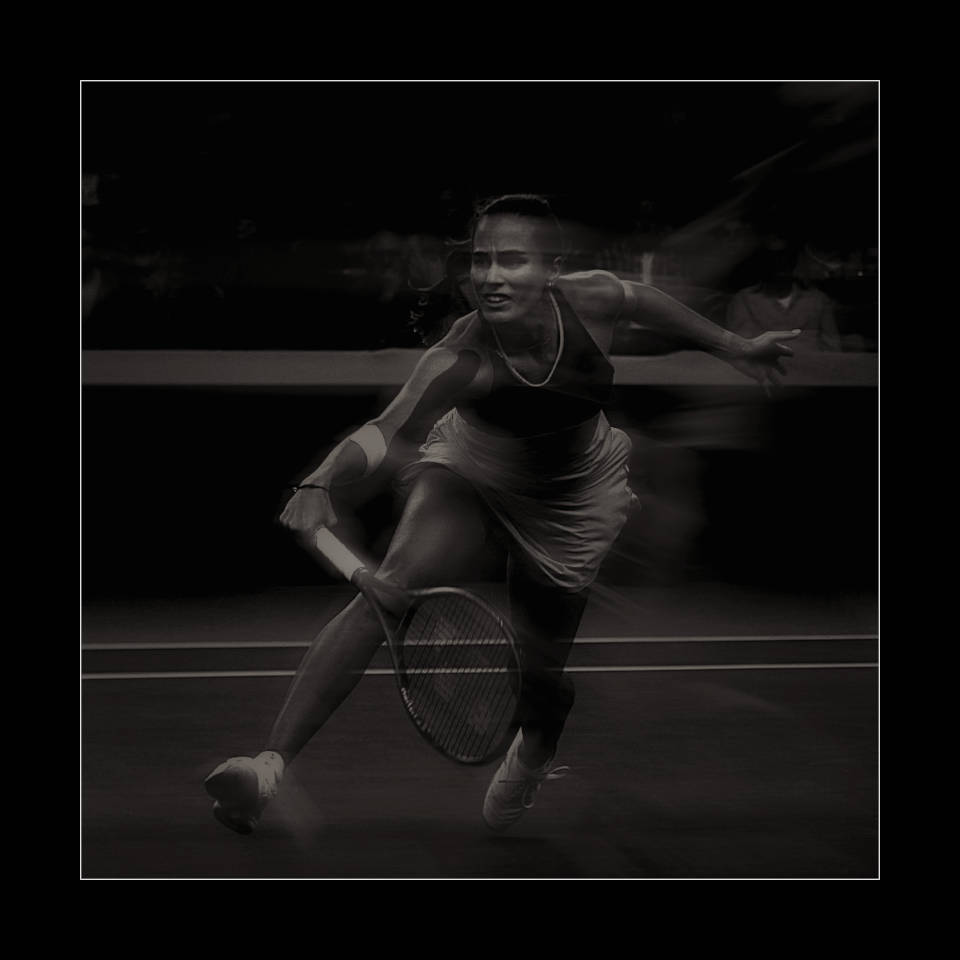
caught between balance and surrender.


Monica Puig – Overview
Monica Puig (born 27 September 1993 in San Juan, Puerto Rico) is a retired Puerto Rican professional tennis player whose historic victory at the 2016 Rio Olympic Games made her one of the most important athletes in Puerto Rican sporting history. A right-handed player with a two-handed backhand, Puig reached a career-high WTA singles ranking of world No. 27 on 26 September 2016. She won the 2014 Strasbourg WTA title and, most famously, the 2016 Olympic singles gold medal, becoming the first athlete representing Puerto Rico to win Olympic gold. Persistent elbow and shoulder injuries eventually forced her to retire in June 2022 at the age of 28.
Early Life
Puig was born in San Juan to José and Astrid Puig. She has an older brother, Ricky. Her mother introduced her to tennis, and one of Puig's earliest memories of the sport was participating in a clinic at a country club.
Her family later moved to the continental United States, and Puig developed much of her tennis in Florida. Although training in the United States, she maintained a strong Puerto Rican identity and represented Puerto Rico throughout her international career.
Junior Career
Puig was an outstanding junior and became one of the leading players of her generation. She reached a career-high ITF junior ranking of world No. 2 in 2010.
She reached the girls' singles final of the 2011 Australian Open, losing to An-Sophie Mestach, and also reached the final of the 2011 Roland Garros junior tournament, where Ons Jabeur defeated her.
These results established Puig as one of the most promising young players moving into professional tennis.
Professional Beginnings
Puig began competing professionally while still a teenager and gradually progressed through the ITF Women's Circuit. She won several ITF singles titles before becoming established on the WTA Tour.
Her rise accelerated during 2012, when she won important ITF tournaments and climbed from outside the Top 200 toward direct entry into major qualifying events. She finished the season ranked world No. 127.
Breakthrough Season – 2013
Puig's major breakthrough came in 2013. She entered the Top 100 and began competing regularly in WTA main draws.
At Roland Garros she defeated former Top-10 player Nadia Petrova in the opening round and advanced to the third round. Only weeks later she produced the best Grand Slam performance of her career at Wimbledon.
Wimbledon 2013
Making her Wimbledon main-draw debut, Puig defeated Johanna Konta, Silvia Soler Espinosa and Eva Birnerová to reach the fourth round.
Her run ended against former US Open champion Sloane Stephens, but reaching the second week of Wimbledon at only 19 established Puig internationally as one of the most exciting young players on tour.
The fourth round remained the best Grand Slam singles result of her professional career.
First WTA Title – Strasbourg 2014
Puig won her first and only official WTA Tour singles title at the Internationaux de Strasbourg in May 2014. She produced an outstanding week on clay and defeated Spain's Sílvia Soler Espinosa 6–4, 6–3 in the final.
The championship demonstrated that despite preferring hard courts, Puig possessed enough movement and baseline consistency to succeed on clay.
Later that year she won the inaugural WTA Rising Stars Invitational in Singapore, defeating Zheng Saisai in the final.
2015 Season
Puig struggled to reproduce the consistency of her breakthrough seasons during 2015. Although she produced several strong individual performances, her ranking fell outside the Top 90 by the end of the year.
The decline meant that she entered 2016 without being regarded as one of the leading players on the WTA Tour. What followed therefore became one of the most unexpected championship stories in modern Olympic tennis.
Strong Start to 2016
Puig began 2016 impressively by reaching the final in Sydney after coming through qualifying. She defeated players including Samantha Stosur and Belinda Bencic before losing to Svetlana Kuznetsova in the championship match.
At the Australian Open she reached the third round, her best result in Melbourne. She subsequently reached the semifinals in Nottingham and Eastbourne during the grass-court season.
Rio Olympic Games – 2016
Puig entered the Rio Olympics ranked world No. 34 and was unseeded. Few observers considered her a likely medalist given a field containing many of the world's leading players.
She proceeded to produce the finest tournament of her career. Puig defeated Polona Hercog, Anastasia Pavlyuchenkova and reigning Roland Garros champion Garbiñe Muguruza during the early rounds, conceding only three games to Muguruza.
She then defeated Laura Siegemund in the quarterfinals to guarantee herself an opportunity to compete for a medal.
Semifinal Against Petra Kvitová
In the semifinals Puig faced two-time Wimbledon champion Petra Kvitová. After splitting the opening two sets, Puig dominated the deciding set to win 6–4, 1–6, 6–3.
The victory placed her in the Olympic final against Germany's Angelique Kerber, who had won the Australian Open earlier that year and would shortly become world No. 1.
Olympic Final Against Angelique Kerber
Puig defeated Kerber 6–4, 4–6, 6–1 in the gold-medal match on 13 August 2016. She played increasingly aggressive tennis as the final progressed and dominated the deciding set.
The victory made Puig the first athlete representing Puerto Rico to win an Olympic gold medal. She was also the first unseeded woman to win the Olympic singles championship since tennis returned to the Games as a full medal sport in 1988.
Historic Significance of the Gold Medal
Puig's victory had significance far beyond tennis. Puerto Rico had participated independently in the Olympic Games since 1948 but had never previously won a gold medal.
The image of Puig standing on the podium while the Puerto Rican anthem played became one of the defining moments in the island's sporting history. Her victory generated enormous celebrations in Puerto Rico and transformed her into a national sporting icon almost overnight.
Puig has consistently described hearing the Puerto Rican anthem during the medal ceremony as the greatest memory of her career.
The Road to Olympic Gold
The quality of Puig's opposition made the championship particularly remarkable. During the tournament she defeated three Grand Slam champions: Garbiñe Muguruza, Petra Kvitová and Angelique Kerber.
Muguruza had won Roland Garros only two months earlier, Kvitová was a two-time Wimbledon champion, and Kerber was the reigning Australian Open champion and eventual 2016 US Open champion.
Puig therefore earned the title through a sequence of victories against some of the strongest players of the era rather than benefiting primarily from an unusually open draw.
Career-High Ranking
Puig's Olympic victory did not itself award WTA ranking points, but her strong results throughout 2016 continued after Rio. She reached the quarterfinals of the Pan Pacific Open in Tokyo and on 26 September 2016 climbed to world No. 27.
This remained the highest singles ranking of her career. She finished the season at No. 32, her best year-end ranking.
2017 Season
Puig found it difficult to reproduce her Olympic form consistently during 2017. The enormous attention surrounding her gold medal also created new expectations that she later acknowledged were difficult to manage at only 22 years old.
Nevertheless, she reached the semifinals in Doha and the final of the Luxembourg Open late in the season. In Luxembourg she lost the championship match to Carina Witthöft.
2018 Season
Puig produced several encouraging results in 2018. At the Miami Open she defeated world No. 2 Caroline Wozniacki and reached the fourth round.
She also reached the semifinals in New Haven and quarterfinals in Monterrey, Québec City and Wuhan. The season demonstrated that although she had fallen from her 2016 peak, she remained capable of defeating elite opponents.
Top-Five Victories
Puig recorded several victories over Top-5 opponents during her career. Among the most notable were wins over Sara Errani at Wimbledon in 2013, Garbiñe Muguruza and Angelique Kerber at the 2016 Olympics, and Caroline Wozniacki in Miami in 2018.
These results illustrate the considerable peak level of her tennis. Puig's career was characterized less by week-to-week consistency than by periods in which her aggressive game could overwhelm even the world's best players.
2019 Season
Puig's 2019 season included several solid results and she finished the year ranked world No. 80. At Roland Garros she reached the third round for the third time in her career.
However, physical problems were becoming increasingly serious. An elbow injury caused by a compressed nerve ultimately produced permanent nerve damage and began a prolonged sequence of medical problems that would dominate the final years of her career.
Injury Problems
Puig's career was severely affected by injuries beginning in 2019. She underwent elbow surgery and later experienced major problems with her right shoulder.
The shoulder injuries involved damage to the biceps, labrum and rotator cuff. Multiple operations and lengthy rehabilitation periods prevented her from maintaining a normal tournament schedule.
Across approximately three years Puig underwent four surgeries, turning what had initially appeared to be temporary interruptions into a prolonged struggle to return to professional tennis.
2020 and 2021
Puig played relatively little during 2020 and was unable to compete at all during much of 2021. Her ranking consequently declined dramatically.
The repeated rehabilitation process was particularly difficult because each attempted comeback required rebuilding the physical conditioning and match sharpness necessary for elite professional tennis.
Final Comeback – 2022
Puig attempted one final return during the spring of 2022. After nearly two years without a WTA match, she returned at the Madrid Open.
She faced 2022 Australian Open finalist Danielle Collins and lost in straight sets. The match ultimately became the final tour-level singles appearance of her professional career.
Retirement
On 13 June 2022 Puig announced her retirement from professional tennis at the age of 28. She explained that after three years of injuries and four surgeries, her body could no longer withstand the demands of professional competition.
Her retirement came considerably earlier than she had hoped. Puig made clear that she would have preferred to end her career on her own terms but recognized that continuing to attempt a full-time comeback was no longer physically realistic.
Grand Slam Record
Puig's best Grand Slam singles performance was the fourth round of Wimbledon in 2013. She compiled a 19–28 career record in Grand Slam singles main draws.
At the Australian Open her best result was the third round in 2016. She reached the third round of Roland Garros in 2013, 2016 and 2019. At the US Open her best performances were second-round appearances in 2014 and 2018.
Australian Open
Puig reached the third round of the Australian Open in 2016, defeating Magda Linette and Kristýna Plíšková before losing to Agnieszka Radwańska.
She recorded six main-draw victories in Melbourne during her career.
Roland Garros
Puig reached the third round of Roland Garros three times. Her first run in 2013 included an upset of former world No. 3 Nadia Petrova.
Although hard court was her preferred surface, clay produced important results throughout her career, most notably her sole WTA Tour championship in Strasbourg.
Wimbledon
Wimbledon produced Puig's finest Grand Slam result. Her fourth-round appearance in 2013 came during her first appearance in the tournament's senior main draw.
She never subsequently matched that run, making the tournament an example of how quickly Puig could produce exceptional tennis when confidence and aggressive ball striking aligned.
US Open
The US Open was statistically Puig's least successful major. She reached the second round in 2014 and 2018 but never advanced further.
Despite spending substantial portions of her development in the United States and preferring hard courts, she was unable to translate those advantages into a deep run in New York.
Playing Style
Puig was a right-handed aggressive baseliner with a two-handed backhand. At 1.70 m (5 ft 7 in), she did not possess the height of the tour's biggest servers and instead depended heavily on explosive movement and forceful groundstrokes.
She attempted to take control of rallies from the baseline, striking aggressively from both wings and looking for opportunities to redirect the ball down the line.
When confident, Puig could play at an exceptionally high tempo. Her Olympic run demonstrated how difficult she could be to contain when consistently striking the ball early and close to the baseline.
Forehand
Puig's forehand was one of her principal attacking weapons. She could generate considerable racquet-head speed and use the shot both cross-court and down the line.
Her best performances were generally characterized by an aggressive forehand that allowed her to control rallies before opponents could establish their own preferred patterns.
Backhand
Her two-handed backhand was compact and capable of producing substantial pace. Puig was comfortable changing direction with the shot and could attack down the line from relatively neutral positions.
The combination of powerful strokes from both wings made her particularly dangerous against opponents who offered her a consistent rhythm from the baseline.
Athleticism and Competitive Intensity
Physical fitness was an important component of Puig's tennis. She was known for her speed, determination and willingness to sustain physically demanding rallies.
Her personal concept of "Pica Power" reflected an approach based on competitive intensity and repeatedly making opponents play another ball. The endurance mentality that characterized her tennis later became central to her post-retirement sporting life.
WTA Tour Record
Puig finished her professional career with a WTA-recorded singles win-loss record of 303–215 and career prize money of $3,570,823.
She won one official WTA Tour singles title, Strasbourg in 2014, and reached two additional WTA finals: Sydney in 2016 and Luxembourg in 2017. Her Olympic championship is recorded separately from her WTA Tour title total.
Doubles Career
Puig concentrated overwhelmingly on singles. Her career-high doubles ranking was world No. 210, achieved on 25 May 2015.
She never won a WTA doubles championship and appeared relatively infrequently in doubles competition. Her professional identity was consequently almost entirely associated with singles.
Representing Puerto Rico
Puig represented Puerto Rico throughout her professional career and played extensively for the Puerto Rican Fed Cup team, now known as the Billie Jean King Cup.
She first represented Puerto Rico in the competition as a teenager and returned repeatedly between 2008 and 2019. Her commitment to representing the island was central to her sporting identity and made the 2016 Olympic triumph especially significant.
Impact in Puerto Rico
Puig's Olympic championship elevated her beyond the normal boundaries of professional tennis. She became a symbol of Puerto Rican sporting achievement and national pride.
Her importance increased further because the victory represented Puerto Rico's first Olympic gold medal in any sport. Puig's name consequently occupies a distinctive position in the island's Olympic history regardless of her relatively modest number of WTA titles.
Humanitarian Work
Puig has also been involved in charitable work in Puerto Rico. Following the devastation caused by Hurricane Maria in 2017, she participated in relief efforts and helped raise funds and resources for affected communities.
She has supported the #YoNoMeQuito foundation, which provides resources and encouragement to Puerto Ricans seeking opportunities for personal and economic development.
Life After Tennis
Puig moved directly into sports broadcasting after retiring. She became a commentator and analyst for ESPN and has also worked with Tennis Channel, allowing her to remain closely connected with professional tennis.
Her broadcasting work has expanded beyond simply describing matches. Her experience as an Olympic champion and former Top-30 player gives her a perspective on tactics, training, pressure, injury and the psychological demands of professional sport.
Endurance Sports
Retirement did not end Puig's competitive sporting ambitions. She became deeply involved in endurance athletics, particularly marathon running and triathlon.
She has completed major marathons including New York, Boston and London and has participated in triathlon and Ironman events. Her transition has been unusually serious for a former professional tennis player and reflects the physical endurance that was already an important element of her tennis career.
Broadcasting and Tennis in 2026
As of 2026, Puig remains highly visible within tennis as a broadcaster, analyst and occasional participant in legends events. She has discussed subjects including match analytics, wearable technology and the increasing role of performance data in professional tennis.
Her post-playing career has therefore developed into a combination of tennis media work, endurance sport and occasional advisory or coaching-related activity.
Personal Life
Puig speaks English and Spanish fluently. Away from tennis she has enjoyed reading, creative writing, going to the beach and spending time with her family and dogs.
She married former Georgia Tech tennis player Nathan Rakitt on 11 November 2022. The couple welcomed their daughter, Mila Alexandra, on 30 July 2025.
Career Highlights
Born: 27 September 1993, San Juan, Puerto Rico
Nationality / representation: Puerto Rico
Height: 1.70 m (5 ft 7 in)
Plays: Right-handed, two-handed backhand
Favorite surface: Hard court
Career-high singles ranking: No. 27 (26 September 2016)
Career-high doubles ranking: No. 210 (25 May 2015)
WTA singles titles: 1
WTA singles champion: Strasbourg (2014)
WTA singles finalist: Sydney (2016), Luxembourg (2017)
Olympic singles champion: Rio 2016
Best Australian Open result: Third round (2016)
Best Roland Garros result: Third round (2013, 2016, 2019)
Best Wimbledon result: Fourth round (2013)
Best US Open result: Second round (2014, 2018)
Career singles record: 303–215
Career prize money: $3,570,823
2016 year-end ranking: No. 32
First Puerto Rican Olympic gold medalist
Turned professional: 2010
Retired: 13 June 2022
Reason for retirement: Persistent elbow and shoulder injuries after four surgeries
Current status: Retired
Career Trajectory
Puig's career followed an unusual trajectory. She was an elite junior, became a Top-100 professional while still young and reached the Wimbledon fourth round at 19. A first WTA championship followed in Strasbourg in 2014, suggesting that she might eventually become a regular member of the world's Top 20.
Her career instead became defined by one extraordinary tournament. Arriving at the Rio Olympics as an unseeded player ranked outside the Top 30, Puig defeated a succession of elite opponents and produced the greatest performance of her career in the gold-medal match against Angelique Kerber.
Although she subsequently reached world No. 27 and remained a dangerous WTA player, Puig never achieved the sustained consistency required to remain near the top of the rankings. Injuries then dramatically shortened her career, with four surgeries over three years ultimately forcing her retirement at only 28.
Assessment
Monica Puig occupies a unique position in tennis history because her importance cannot be measured adequately by rankings or WTA titles. A career-high ranking of No. 27 and one official WTA championship represent a strong professional career, but they do not explain her enduring significance.
The 2016 Rio Olympics does. Puig defeated Grand Slam champions Garbiñe Muguruza, Petra Kvitová and Angelique Kerber on her way to gold and became the first athlete representing Puerto Rico to win an Olympic championship. Few tennis players have produced a single tournament with greater historical significance for their country.
Her career was ultimately shortened by serious injuries, leaving the sense that her full potential was never completely realized. Nevertheless, the Olympic gold medal guarantees Puig a permanent place in both tennis and Puerto Rican sporting history. Since retirement she has successfully created a second athletic and professional life through broadcasting, marathon running and triathlon, remaining closely connected to elite sport long after playing her final WTA match.
all texts by ChatGPT