

the fierce inward quiet of someone surrendering thought to instinct.
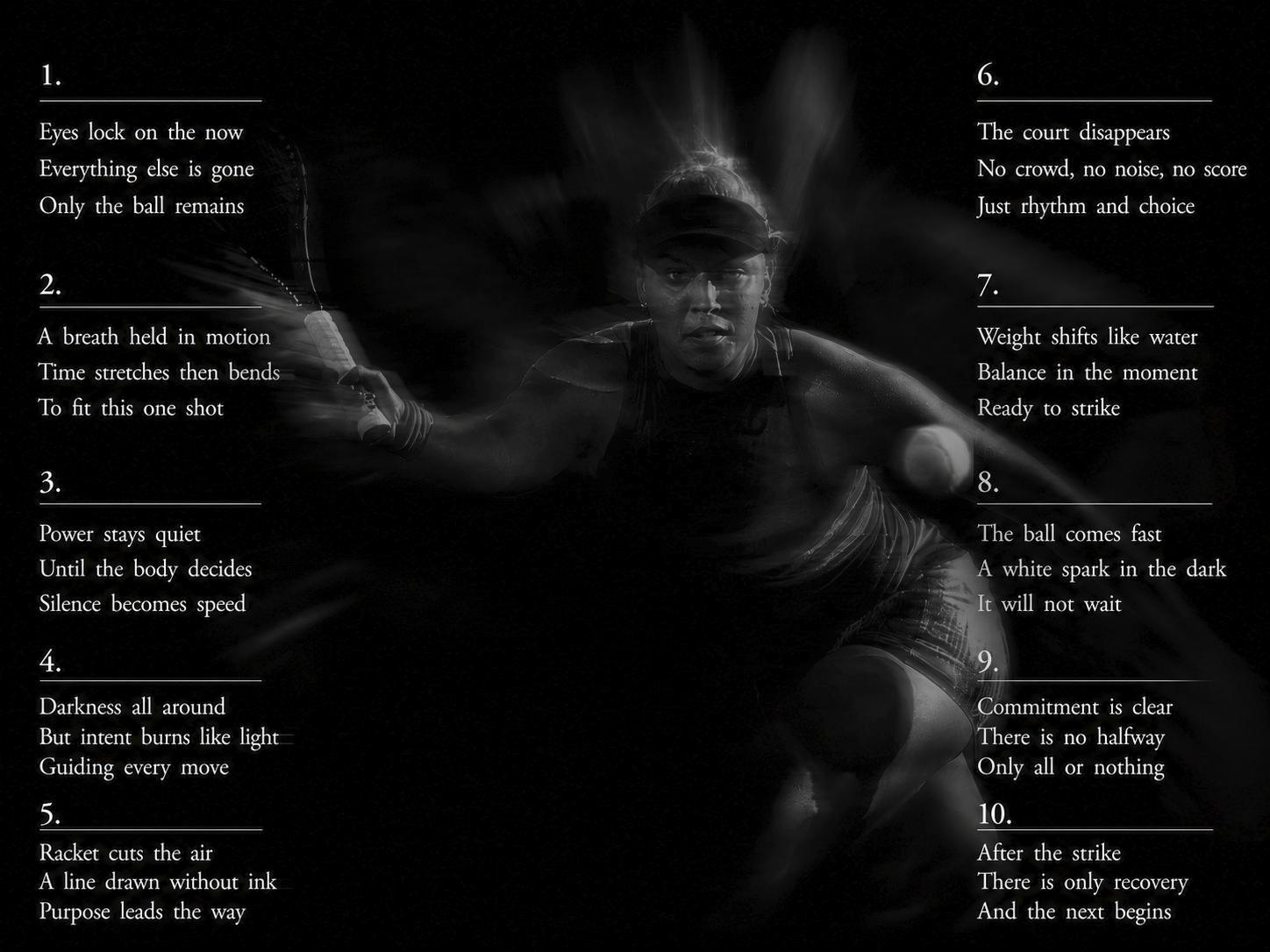


Sabine Lisicki – Overview
Sabine Lisicki (born 22 September 1989 in Troisdorf, West Germany) is a German former professional tennis player best known for her exceptional grass-court game, powerful serve and run to the 2013 Wimbledon singles final. A right-handed player with a two-handed backhand, Lisicki reached a career-high WTA singles ranking of world No. 12 on 21 May 2012 and No. 35 in doubles. She won four WTA singles titles and four WTA doubles titles, reached two Wimbledon finals – singles in 2013 and doubles in 2011 – and represented Germany in the Fed Cup and at the 2012 Olympic Games. Her career was repeatedly interrupted by serious injuries, including a torn ACL in 2020. After a lengthy comeback, she played her most recent professional season in 2024 and is currently listed by the WTA as inactive.
Early Life
Lisicki was born in Troisdorf, near Bonn, to Polish-born parents Richard and Elisabeth Lisicki. Her father, a sports scientist, became closely involved in her tennis development and later served as her coach. Her mother is an artist working in painting and ceramics.
Lisicki began playing tennis at the age of seven. The family later moved to Berlin, where she trained intensively while developing toward professional competition. Financial resources were limited, and her parents made considerable sacrifices to support her early international tournament schedule.
Polish-German Background
Although born and raised in Germany and representing Germany throughout her career, Lisicki has strong Polish family roots and speaks German, English and Polish.
Her parents emigrated from Poland to West Germany before her birth. Lisicki has frequently spoken positively about both elements of her background while identifying professionally and internationally as a German player.
Junior and Early Professional Career
Lisicki competed on the ITF junior circuit before moving rapidly into professional events. She began playing ITF women's tournaments as a teenager and gradually accumulated enough ranking points to enter WTA qualifying competitions.
Her powerful serve and aggressive groundstrokes were already distinguishing features of her game. Unlike many young players whose development centered on defensive consistency, Lisicki possessed obvious first-strike weapons from an early stage.
Professional Breakthrough – 2008
Lisicki's breakthrough came during the 2008 season. She qualified for the Australian Open and defeated former world No. 1 and 1998 champion Lindsay Davenport before reaching the third round.
She also reached her first WTA Tour final in Tashkent, losing to Sorana Cîrstea. The season carried Lisicki into the world's Top 60 and established her as one of Germany's most promising young players.
First WTA Title – Charleston 2009
Lisicki won her first WTA singles title at Charleston in April 2009, one of the most important clay-court tournaments on the women's calendar.
Her run included victories over Venus Williams and Marion Bartoli before she defeated Caroline Wozniacki 6–2, 6–4 in the final. Remarkably, Lisicki completed the entire tournament without losing a set.
The championship demonstrated that despite becoming most closely associated with grass, her attacking game could also succeed on clay.
Wimbledon Breakthrough – 2009
Only months after Charleston, Lisicki produced her first major Wimbledon run. She defeated Anna Chakvetadze, Patricia Mayr, 2009 Roland Garros champion Svetlana Kuznetsova and Caroline Wozniacki to reach the quarterfinals.
Dinara Safina ended her run in three sets. Nevertheless, the tournament established the pattern that would define Lisicki's career: Wimbledon consistently brought out her best tennis.
Injury Crisis – 2010
Lisicki's rapid rise was interrupted in 2010 by a serious ankle injury. She injured her left ankle at Indian Wells and subsequently spent approximately five months away from competition.
Her ranking collapsed from inside the Top 25 to outside the Top 200. The setback began a recurring theme throughout her career: periods of outstanding form were repeatedly followed by lengthy injury interruptions.
Comeback – 2011
Lisicki began 2011 ranked outside the Top 200 but produced one of the strongest comebacks of the WTA season. After gradually rebuilding her ranking, she won the Birmingham grass-court title.
She defeated Daniela Hantuchová in the final and entered Wimbledon with renewed confidence. Her subsequent performance at the All England Club transformed her season.
Wimbledon 2011
Lisicki entered Wimbledon as a wild card and reached the semifinals. Her run included a dramatic second-round victory over reigning Roland Garros champion Li Na, saving match points before winning in three sets.
She subsequently defeated Marion Bartoli in the quarterfinals before losing to Maria Sharapova in the semifinals.
Lisicki became only the second woman in Wimbledon history to reach the semifinals after entering the tournament with a wild card.
Wimbledon Doubles Final – 2011
Lisicki enjoyed simultaneous success in women's doubles at Wimbledon in 2011. Partnering Australian Samantha Stosur, she reached the championship match.
Lisicki and Stosur lost the final to Květa Peschke and Katarina Srebotnik. Nevertheless, reaching both the singles semifinal and doubles final during the same Wimbledon demonstrated Lisicki's exceptional comfort on grass.
Dallas Champion – 2011
Later in 2011 Lisicki won her third WTA singles title in Dallas. She defeated Aravane Rezaï in the final and completed another impressive tournament without dropping a set.
The title helped return her firmly to the WTA elite. Having begun the season outside the Top 200, she finished 2011 ranked world No. 15.
Career-High Ranking
Lisicki continued her progress during the first half of 2012 and reached a career-high singles ranking of world No. 12 on 21 May.
Although she never entered the Top 10, her peak level was clearly capable of challenging the very best players, particularly on grass and faster hard courts.
Wimbledon 2012
At Wimbledon in 2012, Lisicki produced another major upset by defeating world No. 1 and reigning Roland Garros champion Maria Sharapova in the fourth round.
The victory was particularly striking because Sharapova had defeated her in the previous year's Wimbledon semifinal. Lisicki advanced to the quarterfinals before losing to fellow German Angelique Kerber.
London Olympic Games – 2012
Lisicki represented Germany at the 2012 London Olympic Games, where the tennis competition was played at Wimbledon.
She competed in singles, women's doubles and mixed doubles. In mixed doubles she partnered Christopher Kas and reached the bronze-medal match, narrowly missing an Olympic medal after losing to Americans Lisa Raymond and Mike Bryan.
2013 Wimbledon – The Defining Tournament
The defining tournament of Lisicki's career came at Wimbledon in 2013. Seeded No. 23, she once again produced extraordinary tennis on grass and reached her first Grand Slam singles final.
Her path included victories over Francesca Schiavone, Elena Vesnina, Samantha Stosur, Serena Williams and Agnieszka Radwańska.
Victory over Serena Williams
Lisicki faced defending champion and world No. 1 Serena Williams in the fourth round. Williams entered the match on a 34-match winning streak and held three of the four Grand Slam singles titles.
Lisicki won 6–2, 1–6, 6–4, producing one of the greatest victories of her career. She recovered from 0–3 down in the deciding set and withstood Williams's enormous serving and baseline power.
The result reinforced Lisicki's remarkable Wimbledon reputation for defeating reigning Roland Garros champions. Before Williams, she had beaten Svetlana Kuznetsova in 2009, Li Na in 2011 and Maria Sharapova in 2012 shortly after each had won in Paris.
Wimbledon Semifinal – 2013
Lisicki faced world No. 4 Agnieszka Radwańska in an exceptionally close semifinal. After splitting the first two sets, Lisicki fell behind in the deciding set but recovered to win 6–4, 2–6, 9–7.
The victory made her the first German woman since Steffi Graf in 1999 to reach a Grand Slam singles final.
Wimbledon Final – 2013
Lisicki faced Marion Bartoli in the Wimbledon final on 6 July 2013. The German struggled to reproduce the free-flowing tennis that had carried her through the previous rounds and appeared affected by the emotional magnitude of the occasion.
Bartoli won 6–1, 6–4 to capture the championship. Lisicki fought back from 1–5 in the second set and saved several championship points before ultimately losing.
Despite the disappointment, the final remains the greatest Grand Slam achievement of Lisicki's career.
Emotional Connection with Wimbledon
Few players of her generation developed as strong an association with a particular Grand Slam tournament as Lisicki did with Wimbledon. She repeatedly described the All England Club as her favorite tournament and appeared to draw confidence from the atmosphere and grass courts.
Her attacking style was naturally suited to the surface: a huge serve, relatively flat groundstrokes, willingness to attack short balls and the ability to finish points quickly.
2013 Season
Lisicki finished 2013 ranked world No. 15. In addition to Wimbledon, she reached WTA finals in Pattaya City and Memphis.
Her Wimbledon run remained the overwhelming highlight, but the broader season demonstrated that she was capable of sustaining a position around the world's Top 20.
Fastest Serve Record
Lisicki possessed one of the most powerful serves ever recorded in women's tennis. At Stanford in 2014 she delivered a serve measured at 131 mph, approximately 210.8 km/h.
It was recognized as the fastest recorded serve in WTA history. The record became one of the statistics most closely associated with Lisicki and reflected the technical and physical quality of her principal weapon.
Hong Kong Champion – 2014
Lisicki won the fourth and final WTA singles title of her career at the inaugural Hong Kong Tennis Open in September 2014.
She defeated Karolína Plíšková 7–5, 6–3 in the final. The championship was her first WTA singles title since Dallas in 2011 and demonstrated that she remained dangerous away from grass.
2014 Season
Lisicki reached the Wimbledon quarterfinals again in 2014, losing to Simona Halep. This was her fifth quarterfinal-or-better result in six Wimbledon appearances between 2009 and 2014, excluding the tournament she missed in 2010.
She finished the season ranked No. 27, remaining securely inside the world's Top 30.
Indian Wells and Miami – 2015
Lisicki produced one of her strongest non-grass stretches during the North American hard-court spring of 2015. At Indian Wells she reached the semifinals before losing to Jelena Janković.
She followed that result by reaching the Miami quarterfinals, defeating world No. 6 Ana Ivanovic during her run before losing to eventual champion Serena Williams.
27 Aces at Birmingham
During the 2015 Birmingham tournament Lisicki served 27 aces in a match against Belinda Bencic, setting what was then the WTA record for aces in a single match.
The record was subsequently surpassed, but the performance provided another illustration of the extraordinary serving ability that distinguished Lisicki from most of her contemporaries.
US Open 2015
Lisicki reached the fourth round of the US Open in 2015, equaling her best result in New York. She defeated Aliaksandra Sasnovich, Camila Giorgi and Barbora Strýcová before losing to Simona Halep.
Her fourth-round appearances in 2011 and 2015 remain her best US Open results.
Injury Problems from 2015 Onward
After 2015, injuries increasingly prevented Lisicki from maintaining a consistent tournament schedule. Knee problems ended her 2015 season early, while additional physical issues affected the following years.
A shoulder injury delayed the beginning of her 2017 season, during which she played only a limited number of tournaments. Her ranking consequently fell outside the Top 200.
2017 and 2018
Lisicki reached quarterfinals in Mallorca and Washington during 2017. In 2018 her strongest result was a semifinal appearance at the Taipei WTA 125 tournament.
These performances showed flashes of her former level, but repeated physical interruptions made sustained ranking progress increasingly difficult.
2019 Season
Lisicki continued attempting to rebuild during 2019. She played a combination of WTA and ITF tournaments but was unable to return permanently to the Top 100.
She finished the season ranked outside the Top 300, a considerable distance from the elite position she had occupied earlier in the decade.
ACL Injury – 2020
One of the most serious injuries of Lisicki's career occurred at the Linz tournament in November 2020. During a doubles match she fell awkwardly and tore the anterior cruciate ligament in her left knee.
The injury required reconstructive surgery and a lengthy rehabilitation process. Lisicki missed the entire 2021 season.
Given her age and extensive previous injury history, the ACL tear raised serious questions about whether she would ever play professional tennis again.
Return to Professional Tennis – 2022
Lisicki nevertheless returned to competition in May 2022, approximately eighteen months after suffering the ACL injury.
Her most significant result came at the Bad Homburg Open on grass. Playing as a wild card, she defeated Tamara Korpatsch and Greet Minnen to reach the quarterfinals before losing to eventual champion Caroline Garcia.
The run was particularly emotional because it represented her first substantial WTA success after years of injury and rehabilitation.
ITF Comeback – 2023
Lisicki continued her comeback primarily on the ITF circuit during 2023. In November she won the W60 tournament in Calgary, Canada.
She defeated Stacey Fung in the final to capture her first professional singles championship since winning the WTA Hong Kong title more than nine years earlier.
The Calgary victory was one of the most remarkable moments of her comeback, arriving approximately three years after reconstructive knee surgery.
2024 Season
Lisicki continued competing during the first half of 2024. Her ranking reached a season-high position of approximately No. 312, but she was unable to build substantially on the previous year's Calgary championship.
Her tournament activity then stopped during 2024. The WTA currently lists her as inactive rather than maintaining an active ranking.
Motherhood
In March 2024 Lisicki announced that she was expecting her first child. She subsequently stepped away from professional competition and gave birth to a daughter in September 2024.
Motherhood marked another major transition after the long sequence of injuries and comeback attempts that had characterized the later years of her playing career.
Current Status
As of 2026, Lisicki is listed as inactive by the WTA. She has not played a professional tournament since 2024 and no longer holds an active WTA ranking.
She has not established another sustained full-time tour campaign following the birth of her daughter. Her competitive career is therefore effectively inactive, although her later years are notable for the determination required to return after major knee reconstruction and win another professional title in 2023.
Grand Slam Record
Lisicki compiled a 55–35 singles record in Grand Slam main draws. Wimbledon was overwhelmingly her strongest major, where she won 27 of 36 singles matches and reached at least the quarterfinals five times.
Her best Australian Open result was the fourth round in 2012. At Roland Garros she reached the third round in 2013 and 2015. At the US Open she reached the fourth round in 2011 and 2015.
Wimbledon Record
Lisicki's Wimbledon résumé is exceptional relative to her career ranking. She was runner-up in 2013, semifinalist in 2011 and quarterfinalist in 2009, 2012 and 2014.
Between 2009 and 2014 she reached at least the quarterfinals every time she competed at Wimbledon except 2010, when injury prevented her from entering the tournament.
Her record included victories over numerous Grand Slam champions and world No. 1 players, making her one of the most dangerous grass-court specialists of her era.
Playing Style
Lisicki was an aggressive right-handed player with a two-handed backhand. At 1.78 m (5 ft 10 in), she possessed the height and athleticism necessary to generate exceptional serving power.
Her tennis was based on first-strike aggression. She attempted to dominate with the serve, attack returns, take control with her forehand and shorten points whenever possible.
When timing the ball well, Lisicki could overwhelm even elite opponents. The same high-risk approach, however, could produce substantial numbers of unforced errors when her rhythm disappeared.
Serve
The serve was Lisicki's defining technical weapon. Her first delivery combined exceptional speed with considerable natural power and allowed her to accumulate large numbers of aces.
Her 131 mph serve at Stanford in 2014 became the official WTA speed record, while her 27-ace performance against Belinda Bencic at Birmingham in 2015 demonstrated her ability to dominate entire matches from the service line.
On grass, where the low bounce made returns especially difficult, the serve became even more effective.
Forehand
Lisicki's forehand was her principal baseline attacking weapon. She generated substantial racquet-head speed and could strike winners from both central and wide positions.
The forehand worked particularly effectively behind her serve, allowing her to use short returns to finish points with the next shot.
Backhand
Her two-handed backhand was generally more compact than her forehand. She could redirect the ball effectively and use the shot aggressively down the line.
Although less spectacular than her serve or forehand, the backhand gave her sufficient stability to exchange with elite baseline players when her movement and timing were functioning well.
Grass-Court Excellence
Grass was unquestionably Lisicki's defining surface. Her serve became more dangerous, her aggressive groundstrokes penetrated through the court and shorter rallies reduced some of the movement demands that could expose weaknesses on slower surfaces.
Her Wimbledon results greatly exceeded what might normally be expected from a player whose career-high ranking was No. 12. This made her one of the clearest examples of a surface specialist among leading players of her generation.
Success Against Roland Garros Champions
One of the most remarkable patterns in Lisicki's Wimbledon career was her repeated success against Roland Garros champions.
At Wimbledon she defeated Svetlana Kuznetsova in 2009, Li Na in 2011, Maria Sharapova in 2012 and Serena Williams in 2013 immediately after each had won the French Open. She also defeated former Roland Garros champion Francesca Schiavone at Wimbledon in 2013.
The sequence became one of the most distinctive statistical curiosities associated with her career.
Doubles Career
Lisicki was also an accomplished doubles player. She reached a career-high doubles ranking of world No. 35 and won four WTA doubles championships.
Her titles came at Stuttgart in 2011 with Samantha Stosur, Stuttgart in 2013 with Mona Barthel, Miami in 2014 with Martina Hingis and Brisbane in 2015 with Hingis.
The Miami championship was particularly significant because it came at one of the highest-level tournaments on the WTA calendar.
Wimbledon Doubles
Lisicki's finest doubles Grand Slam performance came at Wimbledon in 2011, when she and Samantha Stosur reached the final.
She also reached the US Open doubles quarterfinals in 2012 and the Roland Garros doubles third round in 2013.
Partnership with Martina Hingis
Lisicki formed a particularly successful partnership with former world No. 1 Martina Hingis during the latter stages of her doubles career.
They won the Miami title in 2014 and Brisbane in 2015. Hingis's exceptional touch and tactical awareness complemented Lisicki's serving power and aggressive shot-making.
Fed Cup
Lisicki represented Germany extensively in the Fed Cup, now known as the Billie Jean King Cup, between 2008 and 2015.
She was part of a strong German generation that included Angelique Kerber, Andrea Petkovic and Julia Görges. Germany reached the Fed Cup final in 2014 before losing to the Czech Republic.
German Tennis Context
Lisicki emerged during an important revival in German women's tennis. Following the retirement of Steffi Graf, Germany had spent several years without a consistent group of elite female players.
Lisicki, Kerber, Petkovic and Görges helped change that picture. Each developed a distinctive playing style, with Lisicki becoming the group's most naturally dangerous grass-court player.
Her 2013 Wimbledon final made her the first German woman to contest a Grand Slam singles final since Graf at Wimbledon in 1999.
Injuries and Career Potential
No assessment of Lisicki's career is complete without considering her injury history. Ankle, knee and shoulder problems repeatedly interrupted periods when she appeared capable of establishing herself permanently near the top of the rankings.
The 2010 ankle injury came shortly after her initial breakthrough. Later knee and shoulder problems disrupted her mid-twenties, while the torn ACL in 2020 required one of the most difficult rehabilitation processes in professional sport.
Her ranking history therefore contains dramatic fluctuations that reflect physical interruptions at least as much as changes in playing ability.
Personality and Public Image
Lisicki became known for an unusually cheerful and expressive on-court personality. Her frequent smile and emotional reactions contrasted with the more restrained demeanor of many professional players.
At Wimbledon in particular, her enthusiasm and obvious affection for the tournament made her popular with spectators. The emotional nature of her tennis could be both a strength and vulnerability, generating momentum during successful matches but sometimes making difficult situations harder to manage.
Career Statistics
Full name: Sabine Katharina Lisicki
Born: 22 September 1989, Troisdorf, West Germany
Nationality: German
Height: 1.78 m (5 ft 10 in)
Plays: Right-handed, two-handed backhand
Started playing tennis: Age 7
Career-high singles ranking: No. 12 (21 May 2012)
Career-high doubles ranking: No. 35
WTA singles titles: 4
WTA singles finals: 9
WTA doubles titles: 4
WTA doubles finals: 5
Career singles record: 363–272 at WTA-recorded level
Career prize money: $7,201,957
Fastest recorded WTA serve: 131 mph / approximately 210.8 km/h
Wimbledon singles: Finalist (2013)
Wimbledon singles: Semifinalist (2011)
Wimbledon singles: Quarterfinalist (2009, 2012, 2014)
Australian Open: Fourth round (2012)
Roland Garros: Third round (2013, 2015)
US Open: Fourth round (2011, 2015)
Wimbledon doubles: Finalist (2011, with Samantha Stosur)
US Open doubles: Quarterfinalist (2012)
Olympic Games: London 2012
Fed Cup: German team member 2008–2009 and 2011–2015
Fed Cup finalist: 2014
Final WTA singles title: Hong Kong (2014)
Comeback ITF title: Calgary W60 (2023)
Last professional activity: 2024
Current WTA status: Inactive
WTA Singles Titles
Charleston – 2009, defeated Caroline Wozniacki in the final
Birmingham – 2011, defeated Daniela Hantuchová in the final
Dallas – 2011, defeated Aravane Rezaï in the final
Hong Kong – 2014, defeated Karolína Plíšková in the final
Major Career Milestones
Lisicki's career can be divided into several distinct periods. Between 2008 and 2009 she emerged rapidly from promising young professional to Top-25 player and WTA champion. The serious ankle injury of 2010 then sent her outside the Top 200.
Her 2011 comeback was extraordinary: she returned to the Top 20, won two titles and reached the Wimbledon semifinal. By May 2012 she had climbed to world No. 12.
The 2013 Wimbledon final represented her career peak, while the 2014 Hong Kong title and strong 2015 Indian Wells and Miami results demonstrated that she remained an elite-level threat. Thereafter injuries became increasingly disruptive and eventually removed her from the Top 100.
Her later comeback after ACL reconstruction provided a very different kind of achievement. Returning to a WTA quarterfinal in 2022 and winning the Calgary W60 title in 2023 demonstrated considerable perseverance even though she was unable to regain her former ranking.
Assessment
Sabine Lisicki's career statistics tell only part of her story. Four WTA singles titles and a peak ranking of No. 12 represent an excellent career, but neither figure fully captures how dangerous she could be at her best. On grass in particular, her peak level was comparable with that of Grand Slam champions.
Her 2013 Wimbledon run remains the defining achievement: she defeated world No. 1 Serena Williams during a 34-match winning streak and then survived an extraordinary semifinal against Agnieszka Radwańska before finishing runner-up to Marion Bartoli. Combined with four other Wimbledon quarterfinal-or-better performances, it established Lisicki as one of the outstanding grass-court players of her generation.
Her career also carries a strong sense of unrealized potential because injuries repeatedly interrupted her momentum. Yet those setbacks created another important aspect of her legacy: resilience. Lisicki rebuilt her career after falling outside the Top 200 in 2010 and, more than a decade later, returned from ACL reconstruction to win another professional tournament. Her enormous serve, emotional style and exceptional Wimbledon record ensure that she remains one of the most distinctive German players of the modern era.
all texts by ChatGPT