
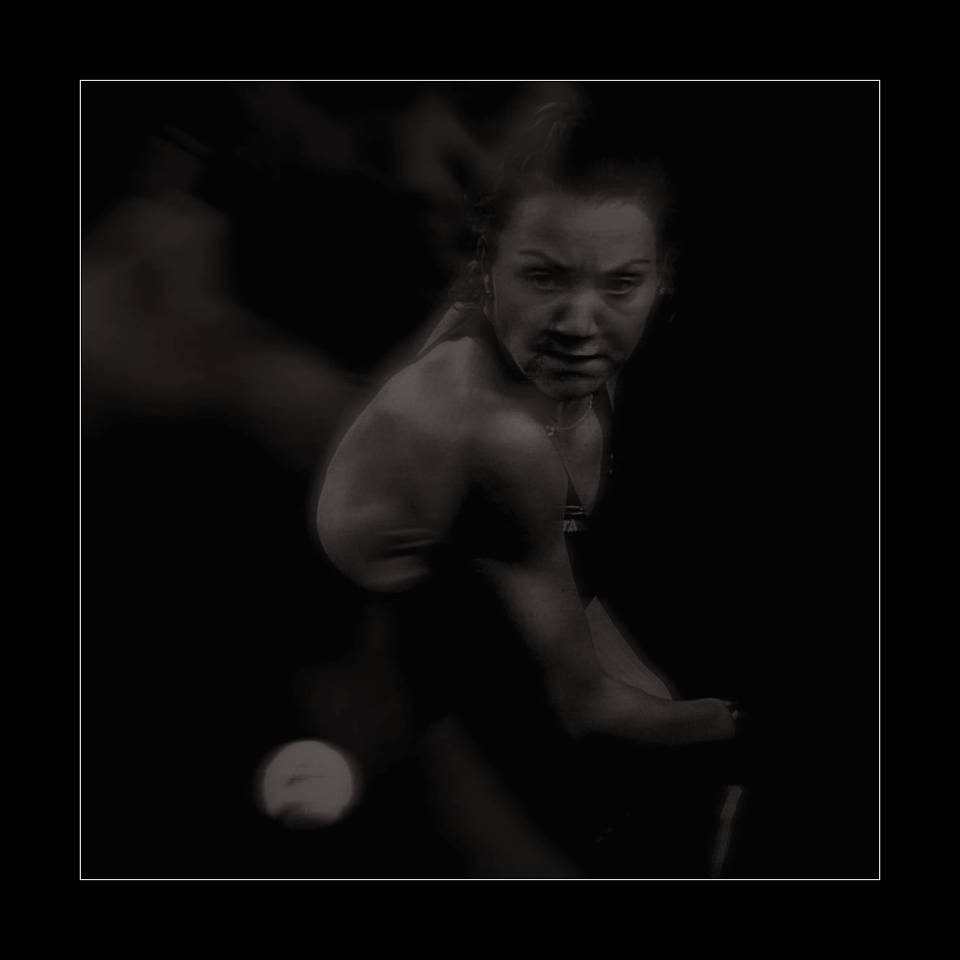
the raw immediacy of someone entirely absorbed in response.

Patricia Maria Țig – Overview
Patricia Maria Țig (born 27 July 1994 in Bucharest, Romania) is a Romanian professional tennis player whose career has been marked by dramatic breakthroughs, lengthy absences and successful comebacks. A right-handed player with a two-handed backhand, she reached a career-high WTA singles ranking of world No. 56 on 26 October 2020. Her principal achievements include winning the 2020 Istanbul Cup, capturing the 2019 Karlsruhe WTA 125 title, reaching WTA finals in Baku and Bucharest, making the quarterfinals of the 2016 Madrid Open and reaching the third round of Roland Garros in 2020. Her career has also included extended interruptions caused by injury and maternity leave.
Early Life and Tennis Development
Țig was born in Bucharest and began playing tennis at the age of eight. She developed within the Romanian tennis system before gradually entering international ITF competition.
At approximately 1.80 m (5 ft 11 in), she possesses considerably more height than many Romanian players of her generation. This gives her useful leverage on serve and allows her to generate penetrating groundstrokes. She has identified hard court as her favorite surface, although many of her most important results have come on clay.
Professional Beginnings
Țig began competing regularly on the ITF Women's Circuit in the early 2010s. Her progression was initially gradual, with most of her tournament schedule consisting of lower-level events in Europe.
She finished 2012 ranked world No. 415 and improved to No. 243 by the end of 2014. During this period she accumulated ITF titles and developed the ranking necessary to begin entering stronger international tournaments.
ITF Breakthrough
Țig's early professional success came primarily on the ITF circuit. She became particularly productive during 2013 and 2014, winning multiple singles and doubles championships.
These results transformed her from a player competing mainly at entry-level professional events into one capable of entering WTA qualifying tournaments. By 2015 she was ready for a significant breakthrough.
WTA Breakthrough – 2015
Țig's first major WTA success came in 2015. At the Bucharest Open she reached the second round as a wild card, recording her first WTA main-draw victory.
Only weeks later she produced an extraordinary run at the Baku Cup in Azerbaijan. Entering through qualifying, she advanced all the way to the singles final.
Baku Final – 2015
Țig defeated several established tour players during her breakthrough run in Baku, including Donna Vekić and former world No. 2 Vera Zvonareva. She also defeated top seed Anastasia Pavlyuchenkova in the semifinals.
In the final she faced Margarita Gasparyan and lost in three sets. Nevertheless, reaching a WTA final from qualifying immediately established Țig as one of the most interesting emerging Romanian players.
She finished 2015 ranked world No. 115, having started the season well outside the established WTA elite.
Madrid Open – 2016
One of the finest tournaments of Țig's career came at the 2016 Madrid Open. She entered the prestigious clay-court event as a qualifier and reached the quarterfinals.
Her run included victories over Daria Kasatkina, Sloane Stephens and Madison Keys. All three would become or already were prominent Top-20-level players, making the sequence one of the strongest achievements of Țig's career.
Her tournament ended in the quarterfinals against Samantha Stosur.
Significance of Madrid 2016
The Madrid result demonstrated that Țig's Baku breakthrough was not an isolated success. Reaching the last eight of a WTA 1000-level event after beginning in qualifying required five consecutive victories against high-quality opposition.
It remains her best performance at one of the WTA's highest tournament levels and showed the effectiveness of her powerful baseline game on clay.
Wimbledon Debut – 2016
Țig made her Grand Slam singles main-draw debut at Wimbledon in 2016. She faced experienced Italian Sara Errani, then seeded No. 20, in the opening round.
Țig lost in straight sets, but the appearance represented another milestone in a season that established her increasingly firmly within the world's Top 100.
Seoul Semifinal – 2016
Later in 2016, Țig reached the semifinals of the Korea Open in Seoul. She defeated several opponents before losing to Lara Arruabarrena.
The result helped her finish the season ranked world No. 112 and maintained her position close to direct entry into the largest tournaments.
Top-100 Breakthrough – 2017
Țig entered the WTA Top 100 for the first time in early 2017. Her strongest result of the first half of the season came at the Miami Open.
Beginning in qualifying, she reached the third round before losing to Venus Williams. The performance helped her climb to approximately world No. 83, then the highest ranking of her career.
Injury Problems – 2017
Țig's progress was abruptly interrupted during 2017 by physical problems. Her season effectively ended at Guangzhou, where she was forced to leave the court in a wheelchair during her opening-round match.
The injury problems proved more serious than a short-term interruption. She subsequently disappeared from professional competition for an extended period.
Maternity Leave
Țig did not play competitive tennis between September 2017 and April 2019. During the absence she also became a mother, giving birth to her daughter Sofia in November 2018.
Because she had been away for such a long period, her WTA ranking disappeared completely. Her eventual return therefore required rebuilding a professional career that had effectively been suspended for approximately nineteen months.
Return to Tennis – 2019
Țig returned to competitive tennis in April 2019. Initially she competed at lower-level ITF tournaments without a conventional WTA ranking.
Her comeback quickly became one of the more remarkable stories of the season. Within only a few months she progressed from small tournaments back to a WTA final.
Bucharest Open Final – 2019
At the 2019 Bucharest Open, Țig entered without a standard WTA ranking but produced an extraordinary run to the final.
Among her victories was an upset of defending champion and world No. 11 Anastasija Sevastova. The victory demonstrated that despite nearly two years away from regular competition, Țig retained the ability to defeat elite opposition.
She eventually lost the final to Elena Rybakina, who was then emerging rapidly toward the top of women's tennis.
Karlsruhe WTA 125 Champion – 2019
Only weeks after the Bucharest final, Țig achieved another major breakthrough by winning the Karlsruhe Open, a WTA 125 tournament in Germany.
The championship was the most important title of her career to that point. It accelerated her ranking recovery and confirmed that the Bucharest run had not simply been the product of home support or an exceptional week.
Extraordinary 2019 Comeback
Țig's 2019 season is particularly notable because she began her comeback without an active ranking and finished the year at world No. 111.
Within approximately seven months she had reached a WTA Tour final, won a WTA 125 championship and returned close to the Top 100. Few players have rebuilt their ranking so rapidly after simultaneous injury and maternity absences.
Maiden WTA Title – Istanbul 2020
Țig achieved the biggest title of her career at the Istanbul Cup in September 2020. Ranked No. 88, she progressed through the clay-court tournament to reach her third WTA singles final.
In the championship match she faced former Wimbledon finalist Eugenie Bouchard. After losing the opening set, Țig recovered to win 2–6, 6–1, 7–6 and capture her first WTA Tour singles title.
At No. 88, she was the lowest-ranked WTA singles champion of the 2020 season.
Roland Garros 2020
Only weeks after winning Istanbul, Țig produced the best Grand Slam performance of her career at Roland Garros.
She defeated Stefanie Vögele in the opening round and Christina McHale in the second round, recording her first two Grand Slam main-draw victories. Her run ended in the third round against Fiona Ferro.
The tournament remains Țig's only appearance in the last 32 of a Grand Slam singles event.
Career-High Ranking
Țig's excellent 2020 season carried her to a career-high WTA singles ranking of world No. 56 on 26 October 2020.
This represented a remarkable transformation. Less than two years earlier she had been absent from the rankings entirely after injury and pregnancy.
She finished 2020 at No. 56, the best year-end ranking of her career.
2021 Season
Țig entered 2021 with direct access to many major WTA tournaments but struggled to reproduce her exceptional 2020 form.
She played the Australian Open, Wimbledon and other tour-level events but accumulated relatively few victories. Her ranking consequently began to fall as points from her strongest results expired.
She finished 2021 ranked world No. 222.
Second Extended Absence
Another lengthy interruption followed. Țig played very little during 2022, and her ranking fell outside the world's Top 700 by the end of the season.
Once again, she faced the difficult process of returning through lower-level tournaments rather than relying on direct WTA entry.
Return in 2023
Țig produced another significant comeback during 2023. Despite entering the season ranked far below her former position, she gradually rebuilt enough form to return to Grand Slam competition.
At the US Open she reached the second round, defeating Canadian qualifier Rebecca Marino before losing to Jessica Pegula. It was her strongest Grand Slam result since Roland Garros in 2020.
US Open
The US Open has become Țig's second-most successful Grand Slam in terms of main-draw victories. She reached the second round in both 2020 and 2023.
Her 2023 appearance was particularly important because it demonstrated that she could still win at Grand Slam level after another lengthy period of ranking decline and limited competition.
2024 ITF Rebuilding
During 2024, Țig spent much of her schedule back on the ITF Women's World Tennis Tour. She won several tournaments, primarily in Romania, as she attempted another ranking rebuild.
Her titles included events in Focșani, Galați, Satu Mare and Brașov, while she also won tournaments at higher ITF level in Bistrița and Istanbul.
The sequence showed that despite being far below her career-high ranking, she remained considerably stronger than many opponents at lower ITF levels.
2025 Season
Țig continued competing during 2025 and reached a season-high singles ranking around world No. 204. She finished the year at approximately No. 348.
Doubles also became increasingly significant. At the Oeiras WTA 125 tournament she reached the doubles final with fellow Romanian-born player Anastasia Detiuc.
The Oeiras result represented one of the most important doubles achievements of her career.
2026 Season
Țig's activity has been very limited in 2026. She reached a season-high singles ranking of No. 398 but subsequently fell sharply as ranking points expired.
By late July 2026 she was ranked around world No. 1070 in singles. The WTA lists her as inactive, with no tour-level singles victories recorded during the season.
Her doubles ranking has remained considerably higher than her singles position, although she has likewise played little competitive tennis during the year.
Current Status
As of 2026, Țig is listed as inactive by the WTA. She has not formally established another sustained tour comeback and currently holds a singles ranking outside the Top 1000.
Given her history, however, inactivity does not necessarily indicate formal retirement. Țig has already returned successfully from two major interruptions during her career, most spectacularly in 2019.
Grand Slam Record
Țig's best Grand Slam singles performance is the third round of Roland Garros in 2020. Her career Grand Slam main-draw record stands at four victories and eleven defeats.
She has appeared in the Australian Open main draw three times, Roland Garros three times, Wimbledon twice and the US Open on multiple occasions.
Australian Open
Țig reached the Australian Open singles main draw in 2017, 2021 and 2023. She lost in the first round on all three occasions.
Despite her hard-court preference, Melbourne has therefore been the least productive major of her career in terms of main-draw victories.
Roland Garros
Roland Garros has produced Țig's finest Grand Slam result. In 2020 she reached the third round, defeating Stefanie Vögele and Christina McHale before losing to Fiona Ferro.
The result followed immediately after her Istanbul championship and came during the strongest period of her professional career.
Wimbledon
Țig made her Wimbledon main-draw debut in 2016 and returned in 2021. She was eliminated in the opening round on both occasions.
Grass has generally been the least natural surface for her game, and she has played relatively few tournaments on it compared with clay and hard courts.
Playing Style
Țig is a right-handed player with a two-handed backhand. At approximately 1.80 m, she possesses the physical dimensions to produce useful serving power and play aggressive first-strike tennis.
Her game is nevertheless more varied than that of a purely power-oriented player. She is comfortable constructing points from the baseline and can use changes of pace and direction to disrupt opponents.
At her best, she combines controlled aggression with sufficient defensive movement to remain competitive in longer rallies.
Forehand
Țig's forehand is an important attacking stroke. She can generate considerable depth and use the shot to move opponents laterally before changing direction.
Her height allows her to strike higher-bouncing balls effectively, an advantage that contributes to her strong results on clay despite hard court being her stated favorite surface.
Backhand
Her two-handed backhand is relatively compact and provides both stability and directional control. She is capable of redirecting pace effectively and using the shot down the line to alter rally patterns.
During her strongest performances, particularly Madrid in 2016 and Istanbul in 2020, her ability to remain solid from both wings prevented opponents from consistently targeting one side.
Serve
At 1.80 m, Țig has greater serving leverage than many players. Her first serve can provide free points and short returns, although it has never been as dominant a weapon as those of the leading power servers on the WTA Tour.
Her best tennis generally occurs when the serve establishes favorable baseline positions rather than when she attempts to rely primarily on aces.
Clay-Court Success
Although Țig officially lists hard court as her favorite surface, clay has produced most of her defining achievements.
Her 2016 Madrid quarterfinal, 2019 Bucharest final, 2019 Karlsruhe WTA 125 championship, 2020 Istanbul title and 2020 Roland Garros third round all came on clay.
The surface gives her time to construct points while allowing her height and groundstroke weight to create penetrating shots even under slower conditions.
Victories over Leading Players
Țig's career contains several notable victories over highly ranked opponents. Her Madrid run included wins over Sloane Stephens and Madison Keys, while in Bucharest in 2019 she defeated world No. 11 Anastasija Sevastova.
She also defeated former world No. 2 Vera Zvonareva during her 2015 Baku breakthrough and former Wimbledon finalist Eugenie Bouchard to win her maiden WTA championship in Istanbul.
Doubles Career
Singles has always been the principal focus of Țig's career, but she has also competed regularly in doubles, particularly on the ITF circuit.
Her most significant result above ITF level came in 2025 when she and Anastasia Detiuc reached the doubles final at the Oeiras WTA 125 tournament.
She has not won a WTA Tour doubles championship.
Romanian Tennis Context
Țig emerged during an exceptionally strong period for Romanian women's tennis. Her career overlapped with Simona Halep, Irina-Camelia Begu, Sorana Cîrstea, Monica Niculescu, Mihaela Buzărnescu and Ana Bogdan.
The depth of Romanian women's tennis made national prominence particularly difficult to achieve. Nevertheless, reaching world No. 56 placed Țig firmly among the country's significant WTA-level players of her generation.
Motherhood and Professional Tennis
Țig's return after becoming a mother is one of the defining elements of her career. She gave birth to daughter Sofia in November 2018 and returned to professional competition only months later.
Within the following year and a half she reached a WTA final, won a WTA 125 championship, captured her first WTA Tour title, reached the third round of Roland Garros and climbed to world No. 56.
That sequence makes her comeback particularly notable within the context of professional women's tennis.
Career Prize Money
By May 2026, Țig had earned approximately $1.675 million in official career prize money.
She passed the $1 million mark during her third-round run at Roland Garros in 2020, at the peak of the most successful period of her career.
Career Highlights
Full name: Patricia Maria Țig
Born: 27 July 1994, Bucharest, Romania
Nationality: Romanian
Height: 1.80 m (5 ft 11 in)
Plays: Right-handed, two-handed backhand
Started playing tennis: Age 8
Preferred surface: Hard court
Career-high singles ranking: No. 56 (26 October 2020)
WTA singles titles: 1
WTA singles champion: Istanbul (2020)
WTA singles finalist: Baku (2015), Bucharest (2019)
WTA 125 singles titles: 1
WTA 125 champion: Karlsruhe (2019)
WTA 125 doubles finals: 1
WTA 125 doubles finalist: Oeiras (2025, with Anastasia Detiuc)
Best WTA 1000 result: Madrid quarterfinal (2016)
Best Australian Open result: First round (2017, 2021, 2023)
Best Roland Garros result: Third round (2020)
Best Wimbledon result: First round (2016, 2021)
Best US Open result: Second round (2020, 2023)
First Top-100 ranking: 2017
Best year-end ranking: No. 56 (2020)
2019 year-end ranking: No. 111
2021 year-end ranking: No. 222
2022 year-end ranking: No. 796
2023 year-end ranking: No. 431
2024 year-end ranking: No. 251
2025 year-end ranking: No. 348
2026 singles ranking: Outside the Top 1000 by late July
Career prize money: Approximately $1.675 million
Daughter: Sofia, born November 2018
Current WTA status: Inactive
Career Trajectory
Țig's career is unusually fragmented. Her first rise took her from the ITF circuit to the 2015 Baku final, the Madrid quarterfinals and the Top 100. Injury then removed her from professional tennis just as she appeared capable of establishing herself permanently at WTA level.
Her return following injury and motherhood was even more successful than her first career phase. Starting virtually from scratch in 2019, she reached the Bucharest final, won Karlsruhe and returned to the Top 100. In 2020 she went further, winning Istanbul, reaching the Roland Garros third round and climbing to world No. 56.
A second period of physical problems and limited competition again sent her ranking downward. She subsequently returned to Grand Slam level in 2023 and rebuilt through ITF tournaments during 2024, but by 2026 her schedule had again become extremely limited.
Assessment
Patricia Maria Țig's career is defined as much by her comebacks as by her rankings and titles. A career-high position of No. 56, one WTA championship and one WTA 125 title represent a substantial professional résumé, but the circumstances under which those achievements were produced make them more remarkable.
Her 2016 Madrid quarterfinal demonstrated genuine Top-30-level potential, while her 2019 return after nearly two years away from competition showed exceptional resilience. Within sixteen months of returning after childbirth, she had won both WTA 125 and WTA Tour titles and reached the third round of a Grand Slam.
Her career never developed into the uninterrupted Top-50 run that her peak performances suggested was possible. Injuries and extended absences repeatedly interrupted momentum. Nevertheless, Țig's ability to rebuild from virtually no ranking on multiple occasions, combined with her Istanbul championship and career-high No. 56 ranking, makes her one of the more distinctive Romanian players of her generation.
all texts by ChatGPT