
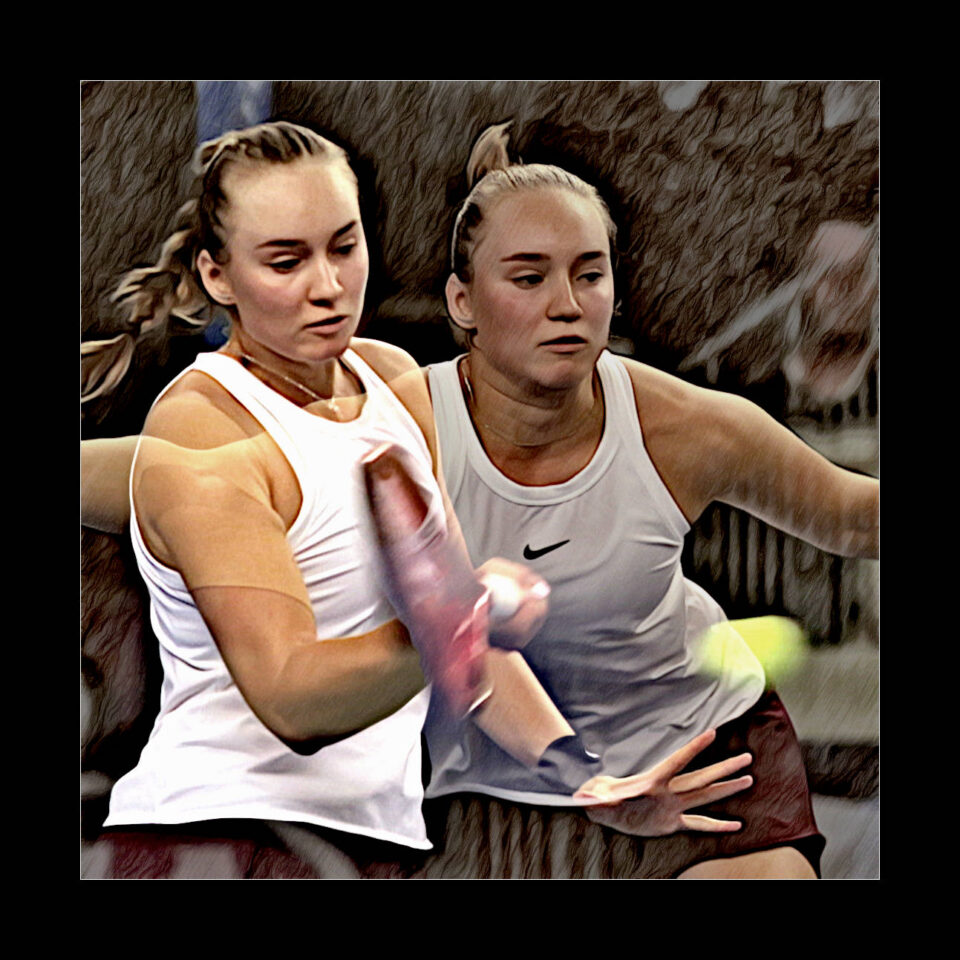
US Open 2026 Women’s Final
Elena Rybakina def. Aryna Sabalenka 6–4, 5–7, 6–2
The 2026 US Open women’s final brought together two of the most powerful players of the modern game, but the decisive difference was not simply raw pace. Rybakina handled her power with greater efficiency, absorbed Sabalenka’s aggression more cleanly and remained tactically composed when the match became tense.
With the victory, Rybakina claimed her first US Open title, her third Grand Slam singles title and her second major of 2026 after also defeating Sabalenka in the Australian Open final. She also ended Sabalenka’s two-year reign as US Open champion and became the new world No. 1.
First Set – Rybakina Takes Control
Rybakina immediately established the backhand as one of the central weapons of the match. Sabalenka normally uses her heavy crosscourt ball to force opponents onto the defensive, but Rybakina repeatedly absorbed that pace and redirected it with compact, flat strokes.
Her return game was equally important. She did not need spectacular return winners; instead, she neutralised enough of Sabalenka’s first serves to prevent the easy serve-plus-forehand patterns that usually allow Sabalenka to dominate quickly.
Sabalenka came under pressure early and eventually surrendered serve in the middle of the set. Her frustration became visible, while Rybakina remained calm and mechanically precise. Even without serving at her absolute best, Rybakina controlled enough baseline exchanges to take the opening set 6–4.
Why the Matchup Favoured Rybakina
The players are often grouped together because both possess exceptional first-strike power, yet the mechanics of that power are different. Sabalenka’s tennis is explosive and physically expressive. Rybakina’s is more linear, compact and economical.
Against most opponents Sabalenka’s first aggressive ball produces a weaker reply. Against Rybakina it often produced another attacking ball. Sabalenka was therefore forced to hit several high-quality shots in succession rather than one decisive blow.
That gradually pushed her toward the lines and increased her error rate. Rybakina, meanwhile, was able to remain aggressive without taking quite the same degree of risk.
Second Set – Sabalenka Responds
Sabalenka’s response in the second set was impressive. She became more patient, used greater depth through the middle of the court and stopped trying to end every rally immediately.
Her backhand improved significantly, particularly crosscourt, where she began pushing Rybakina wider before attacking the open space. She also introduced more variation and showed greater willingness to construct points rather than relying entirely on maximum pace.
Rybakina survived pressure at 5–4, but Sabalenka kept applying it. At 5–6, she finally broke, attacking a second serve and finishing the set with a powerful backhand return down the line.
The match was level at one set all, and the momentum appeared to have shifted toward Sabalenka.
The Crucial Reset
The most impressive part of Rybakina’s performance came immediately after losing the second set.
She did not panic, overreact or change her tactical approach. She simply returned to the patterns that had worked earlier. That emotional reset was arguably the decisive moment of the final.
Sabalenka had just completed a difficult comeback, the crowd was responding strongly to her energy, and the match had become a one-set shootout. Rybakina behaved as though none of that mattered.
Third Set – Rybakina Pulls Away
Rybakina broke early in the deciding set and then raised her serving level. Sabalenka struggled to create meaningful pressure in return games, while Rybakina repeatedly landed the first attacking shot.
Once ahead, Rybakina became increasingly difficult to disturb. Her service games were quick and efficient, forcing Sabalenka to play every remaining service game with scoreboard pressure.
A second break gave Rybakina a 5–2 lead. She then served for the title and closed the match appropriately with an ace.
The Tactical Key – Rybakina’s Return
Rybakina’s serve naturally receives most of the attention, but her returning was arguably the most important technical feature of the final.
She repeatedly forced Sabalenka into difficult service games. Even when Sabalenka escaped break points, she was rarely able to move through games comfortably.
That mattered because Sabalenka is accustomed to controlling matches through her serve. Rybakina did not need to dominate it outright. She only needed to make Sabalenka think about holding serve.
That alone changed the psychological balance of the match.
The Backhand Battle
Rybakina’s backhand was probably her best groundstroke on the day. Its compact preparation allowed her to redirect Sabalenka’s pace without giving up court position.
Sabalenka could not rely on the usual pattern of driving heavily crosscourt and waiting for a short reply. Rybakina frequently sent the ball back with equal depth and sometimes changed direction down the line.
This made Sabalenka’s own power less effective. Instead of overwhelming Rybakina, it often supplied her with useful pace.
Sabalenka’s Emotional Challenge
Sabalenka’s frustration was visible at several stages of the match. That was not the sole reason she lost, but it contrasted sharply with Rybakina’s steadiness.
Rybakina’s expression and body language barely changed between winners, break points, lost games or even the loss of the second set. That consistency had practical value because it allowed her to begin the third set with the same clarity she had shown in the first.
Sabalenka appeared to spend more emotional energy reacting to previous points, particularly once the deciding set began to move away from her.
Sabalenka’s Strong Second Set
Despite the 6–2 score in the final set, this was not a straightforward match. Sabalenka deserves considerable credit for forcing a third set after being tactically outplayed for significant periods.
Her second-set adjustments were intelligent. She became more patient, used the middle of the court more effectively and found a better balance between aggression and construction.
The problem was that she could not sustain that balance once Rybakina raised her level again.
What Rybakina Did Better
The most revealing feature of Rybakina’s performance was the combination of aggression and reliability.
Against Sabalenka, opponents usually face an uncomfortable choice: play safely and risk being overpowered, or attack aggressively and accept a high error count.
Rybakina managed to do both jobs at once. She attacked Sabalenka consistently without becoming the less stable player.
That balance was the foundation of her victory.
What the Victory Means for Rybakina
Rybakina now holds three Grand Slam singles titles:
- Wimbledon 2022
- Australian Open 2026
- US Open 2026
Only Roland Garros is missing from a potential career Grand Slam.
More significantly, she won both hard-court majors in 2026 and defeated Sabalenka in both finals. That gives the season considerable historical weight and strengthens the argument that Rybakina has become the leading hard-court player of the year.
Her rise to world No. 1 also changes the perception of her career. She is no longer simply an exceptional server capable of winning major tournaments. Her return game, defensive tolerance and psychological resilience have developed to the point where she can now control the biggest matches.
What the Defeat Means for Sabalenka
Sabalenka’s 2026 season was still highly successful, but the defeat left her without a Grand Slam title for the year.
The more significant issue may be the emerging rivalry with Rybakina. Sabalenka defeated her in other major tournaments during the season, so the matchup cannot be described as one-sided.
However, Rybakina won the two most important meetings: the Australian Open final and the US Open final.
That gives their rivalry a new psychological dimension. When the stakes were highest in 2026, Rybakina came through.
Overall Assessment
Match quality: 8.5/10
Drama: 8.5/10
Rybakina: 9/10
Sabalenka: 7.5/10
The second set made the final genuinely competitive, but the third set defined the champion. Rybakina had just lost a set she could easily have won, Sabalenka had momentum and the crowd was increasingly engaged in the comeback.
Rybakina simply reset.
She broke early, protected her serve, broke again and finished the tournament with an ace.
The score was 6–4, 5–7, 6–2, but the deeper message was clear. Sabalenka has long been one of the defining reference points for power tennis on hard courts. In this final, Rybakina matched that power while playing with greater economy, lower visible risk and superior tactical clarity.
That is why she left Arthur Ashe Stadium not only as the 2026 US Open champion, but also as the new world No. 1.