an instinctive negotiation with gravity. Elise Mertens — Compact Overview Basic Information Full name: Elise Mertens Nationality: Belgian Born: 17 November 1995, Leuven, Belgium Residence: Ham, Belgium Height: 1.79 m
welcome to beautyoftennis.com | all rights reserved
CHRISTIAN BROCKMEIER / ARTIST STATEMENT
THE BEAUTY OF TENNIS
In the Fire of Now — An Artist’s Statement
There is nothing but the moment.
The past has vanished, the future has not yet arrived. What we call life takes place in the infinitely narrow space between the two. And yet, within this fleeting instant, an entire world can unfold.
For me, the essential quality of human existence is abandon: the capacity to devote oneself so completely to an activity that everything else loses its significance. It hardly matters whether this happens in music, craftsmanship, art, or sport. What matters is the surrender itself — that rare state in which concentration becomes effortless, intention and action merge, and the distinction between the person and what they are doing begins to disappear.
Tennis offers an extraordinary manifestation of this condition.
A player entering the court crosses an invisible threshold. The ordinary person becomes someone else: a being of movement, anticipation, instinct, intelligence, and will. For hours, body and mind must remain alert to a constantly changing reality. Every ball presents a new situation, every movement demands a response. There is no time to dwell on what has happened, and little room to contemplate what might follow. There is only the next ball, the next movement, the next decision.
Winning is not what fascinates me. Nor is fame, money, or the hierarchy of rankings. What fascinates me is the intensity of commitment, the struggle against fatigue and discouragement, the extraordinary discipline of remaining present.
I have photographed internationally celebrated champions and players whose names are scarcely known beyond the smallest tournaments. To me, the distinction is irrelevant. The same devotion can be found on a Grand Slam centre court and on court twelve of a modest ITF event. The same concentration, the same vulnerability, the same willingness to give everything to a single fleeting instant.
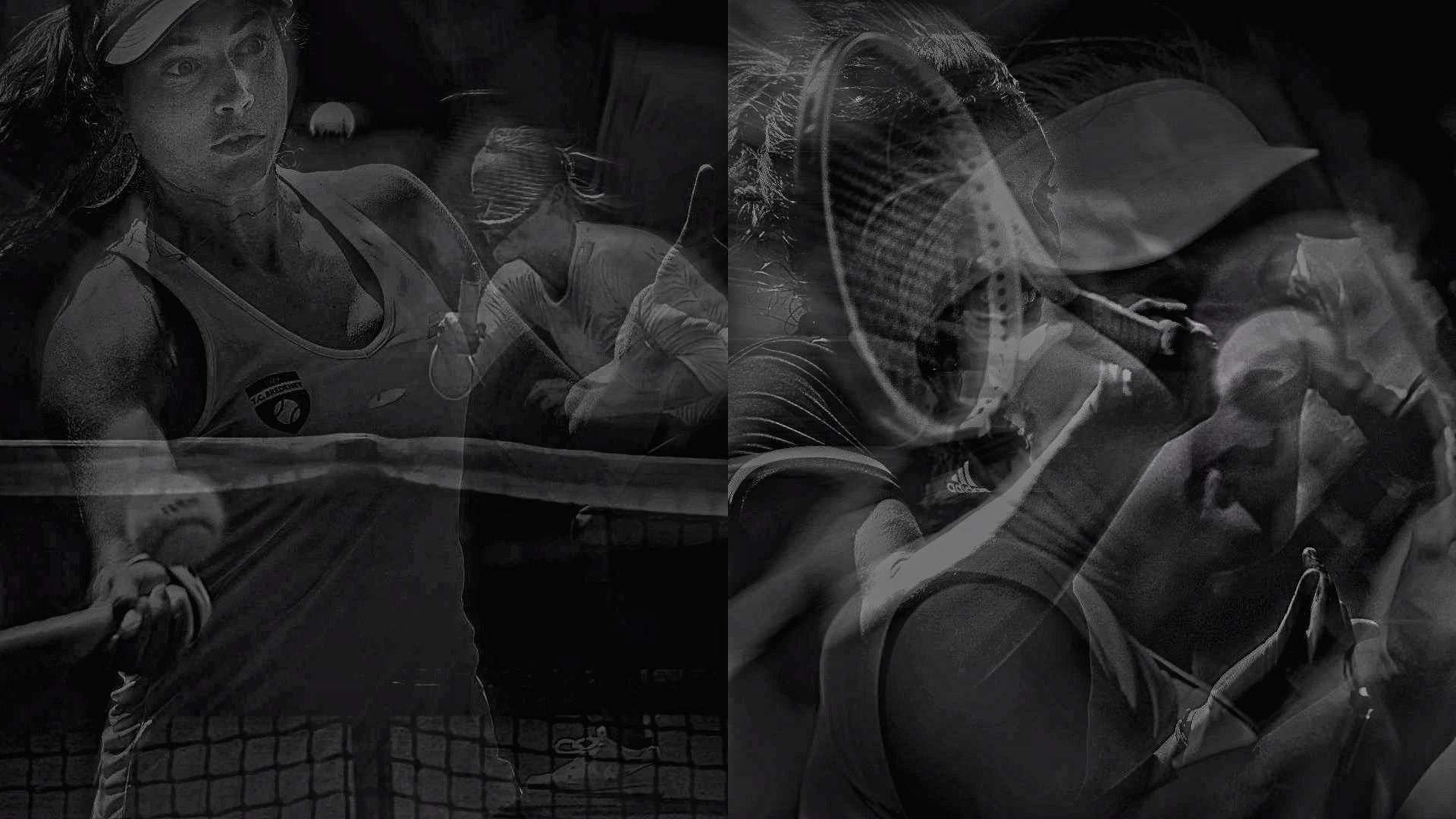
My photographs are an attempt to make this invisible intensity visible.
The decisive moment is often the instant of contact between racket and ball. Without relying on automated sequences, photographing it requires a particular kind of synchronization. The photographer must enter the rhythm of the player, anticipate her movement, and become, for a fraction of a second, part of the event. As a musician, I recognize something deeply familiar in this process: timing, rhythm, improvisation, and the delicate relationship between anticipation and response.
Movement is life. Stillness, in photography, is only its temporary disguise.
Yet my images are not intended to describe tennis in the conventional sense. I am not interested in illustrating a match, documenting a result, or celebrating a victory. I want to isolate those moments in which the ordinary world seems to fall away and something more essential becomes visible.
This is why darkness plays such a central role in my work.
Jun'ichirō Tanizaki's In Praise of Shadows has long resonated with my understanding of beauty. Not everything needs to be illuminated. Mystery, suggestion, and the unseen may reveal more than complete visibility ever could.
The eleventh chapter of the Tao Te Ching offers another important thought: the usefulness of a vessel lies in its emptiness. In my photographs, blackness is not merely an absence of information. It is an active element of composition, a space in which the essential can emerge.
The court disappears. The spectators vanish. The surrounding noise is silenced. What remains may be a face, a hand, a body suspended in movement, the luminous sphere of a tennis ball — and the invisible relationship connecting them.
The emptiness gives these fragments their presence.
Black and white, for me, is not nostalgia. It is a form of concentration. Colour can delight, excite, and entertain; monochrome allows me to move away from spectacle towards something closer to ritual.
Modern professional tennis is increasingly surrounded by commerce, celebrity, advertising, and theatrical excess. I do not deny the excitement of the spectacle, but my allegiance lies elsewhere: with the culture of the game, its discipline, its traditions of fairness, and the extraordinary human commitment at its centre.
Women's tennis has become my chosen subject because it brings together several things I deeply value: the power and individuality of women, the beauty of physical movement, the intelligence of athletic performance, and the possibility of complete devotion.
I do not seek idealized heroines. I seek human beings in moments when their ordinary identities are temporarily transcended by what they do.
A photograph can never preserve the moment itself. The moment is already gone. What remains is a trace — a fragment of movement, a fleeting expression, a gesture that will never occur in precisely the same way again.
Perhaps that is the paradox at the heart of photography: it attempts to give permanence to what exists only through its disappearance.
THE BEAUTY OF TENNIS is my exploration of that paradox. It is a celebration of women's tennis, certainly, but beyond that, it is a meditation on movement, devotion, transience, and the beauty of being entirely present.
Beyond the swing, beyond the point, beyond winning — there is the fire of now.
CHRISTIAN BROCKMEIER / ARTIST STATEMENT
THE BEAUTY OF TENNIS
Im Feuer der Gegenwart — Ein künstlerisches Statement
Es gibt nichts außer dem Augenblick.
Die Vergangenheit ist verschwunden, die Zukunft noch nicht eingetreten. Was wir Leben nennen, vollzieht sich in dem unendlich schmalen Raum dazwischen. Und doch kann sich innerhalb dieses flüchtigen Augenblicks eine ganze Welt entfalten.
Für mich liegt eine wesentliche Qualität menschlicher Existenz in der Fähigkeit zur vollständigen Hingabe. In jenem Zustand, in dem ein Mensch so sehr in einer Tätigkeit aufgeht, dass alles andere seine Bedeutung verliert. Ob dies in der Musik geschieht, im Handwerk, in der Kunst oder im Sport, spielt letztlich keine Rolle. Entscheidend ist die Hingabe selbst: jener seltene Zustand, in dem Konzentration selbstverständlich wird, Absicht und Handlung miteinander verschmelzen und die Grenze zwischen dem Menschen und seinem Tun zu verschwinden beginnt.
Tennis ist eine außergewöhnliche Erscheinungsform dieses Zustands.
Eine Spielerin, die den Platz betritt, überschreitet eine unsichtbare Schwelle. Aus dem gewöhnlichen Menschen wird ein anderes Wesen: ganz Bewegung, Erwartung, Instinkt, Intelligenz und Wille. Über Stunden müssen Körper und Geist auf eine sich unablässig verändernde Wirklichkeit reagieren. Jeder Ball schafft eine neue Situation, jede Bewegung verlangt eine Antwort. Für das Vergangene bleibt keine Zeit, für die Zukunft kaum Raum. Es gibt nur den nächsten Ball, die nächste Bewegung, die nächste Entscheidung.
Nicht das Gewinnen fasziniert mich. Auch nicht Ruhm, Geld oder die Rangordnung des Erfolgs. Mich fasziniert die Intensität der Hingabe, der Kampf gegen Müdigkeit und Entmutigung, die außerordentliche Disziplin, vollkommen gegenwärtig zu bleiben.
Ich habe international gefeierte Spitzenspielerinnen fotografiert und solche, deren Namen außerhalb kleinster Turniere kaum jemand kennt. Für mich ist dieser Unterschied bedeutungslos. Dieselbe Hingabe findet sich auf dem Centre Court eines Grand-Slam-Turniers wie auf Platz zwölf einer bescheidenen ITF-Veranstaltung. Dieselbe Konzentration, dieselbe Verletzlichkeit, dieselbe Bereitschaft, alles in einen einzigen flüchtigen Augenblick zu legen.
Meine Fotografien sind der Versuch, diese unsichtbare Intensität sichtbar zu machen.
Der entscheidende Moment ist häufig jener winzige Augenblick, in dem Schläger und Ball aufeinandertreffen. Ihn ohne automatische Bildserien festzuhalten, verlangt eine besondere Form der Synchronisation. Der Fotograf muss sich in den Rhythmus der Spielerin hineinbegeben, ihre Bewegung vorwegnehmen und für den Bruchteil einer Sekunde selbst Teil des Geschehens werden.
Als Musiker erkenne ich darin etwas zutiefst Vertrautes: Timing, Rhythmus, Improvisation und das empfindliche Zusammenspiel von Erwartung und Reaktion.
Bewegung ist Leben. Stillstand ist in der Fotografie nur ihre vorübergehende Verkleidung.
Dennoch wollen meine Bilder Tennis nicht im herkömmlichen Sinne beschreiben. Es geht mir nicht darum, ein Match zu illustrieren, ein Ergebnis zu dokumentieren oder einen Sieg zu feiern. Ich möchte jene Augenblicke isolieren, in denen die alltägliche Welt zurückzutreten scheint und etwas Wesentlicheres sichtbar wird.
Deshalb spielt die Dunkelheit in meiner Arbeit eine so zentrale Rolle.
Jun'ichirō Tanizakis Lob des Schattens entspricht seit Langem meinem Verständnis von Schönheit. Nicht alles muss ausgeleuchtet werden. Das Geheimnis, die Andeutung und das Unsichtbare können mehr offenbaren als die vollständige Sichtbarkeit.
Ein weiterer wichtiger Gedanke findet sich im elften Kapitel des Tao Te King: Der Nutzen eines Gefäßes liegt in seiner Leere. In meinen Fotografien ist das Schwarz nicht einfach die Abwesenheit von Information. Es ist ein aktives Gestaltungselement, ein Raum, in dem das Wesentliche hervortreten kann.
Der Tennisplatz verschwindet. Die Zuschauer lösen sich auf. Der Lärm der Umgebung verstummt. Was bleibt, ist vielleicht ein Gesicht, eine Hand, ein Körper inmitten einer Bewegung, die leuchtende Kugel eines Tennisballs – und die unsichtbare Beziehung zwischen ihnen.
Die Leere verleiht diesen Fragmenten ihre Gegenwart.
Schwarzweiß ist für mich keine Nostalgie. Es ist eine Form der Konzentration. Farbe kann erfreuen, begeistern und unterhalten. Die Reduktion auf Schwarzweiß erlaubt mir, mich vom Spektakel zu entfernen und mich etwas anzunähern, das eher einem Ritual gleicht.
Der professionelle Tennissport ist zunehmend von Kommerz, Starkult, Werbung und inszeniertem Überschwang umgeben. Ich bestreite nicht den Reiz dieses Spektakels, aber meine Zuneigung gilt etwas anderem: der Kultur des Spiels, seiner Disziplin, seinen Traditionen der Fairness und der außerordentlichen menschlichen Hingabe in seinem Innersten.
Frauentennis ist zu meinem bevorzugten Thema geworden, weil sich darin vieles vereint, was mir wesentlich erscheint: die Kraft und Individualität von Frauen, die Schönheit körperlicher Bewegung, die Intelligenz sportlicher Leistung und die Möglichkeit vollständiger Hingabe.
Ich suche keine idealisierten Heldinnen. Ich suche Menschen in Augenblicken, in denen sie durch ihr Tun vorübergehend über ihre alltägliche Existenz hinauswachsen.
Eine Fotografie kann den Augenblick selbst niemals bewahren. Er ist bereits vergangen. Was bleibt, ist eine Spur – das Fragment einer Bewegung, ein flüchtiger Gesichtsausdruck, eine Geste, die sich niemals auf genau dieselbe Weise wiederholen wird.
Vielleicht liegt darin das Paradox der Fotografie: Sie versucht, etwas Dauer zu verleihen, das nur in seinem Vergehen existiert.
THE BEAUTY OF TENNIS ist meine Auseinandersetzung mit diesem Paradox. Eine Hommage an das Frauentennis, gewiss. Darüber hinaus aber eine Betrachtung über Bewegung, Hingabe, Vergänglichkeit und die Schönheit vollständiger Gegenwärtigkeit.
Jenseits des Schlags, jenseits des Ballwechsels, jenseits des Siegens – liegt das Feuer des Augenblicks.